

To recruit an apprentice, you pick an approved apprenticeship standard, choose a training provider, agree a price, advertise a real job with training built in, interview for potential rather than experience, then sign the contract, apprenticeship agreement and training plan. The rules below apply to England. Scotland, Wales and Northern Ireland run their own schemes. This guide walks through each stage in order, with the current pay rates, funding rules and advert requirements.
TL;DR
- An apprenticeship is a real job with structured training. You employ the apprentice, pay at least the apprentice National Minimum Wage and release them for off-the-job training.
- Choose the standard and provider first, then agree the paid off-the-job training hours required for that standard and start date.
- From August 2026, eligible apprenticeship training for 16–24-year-olds with non-levy employers is fully funded under the applicable rules. This does not pay the apprentice’s wages.
- Interview for motivation, attitude and willingness to learn. Apprentices are not expected to arrive with experience.
- Sign three documents once an offer is accepted: contract of employment, apprenticeship agreement and training plan.
What you are actually hiring: an employee who trains
An apprenticeship is a job first. According to the government’s apprenticeships service, apprentices earn while they learn, build skills and behaviours tailored to a specific role, are trained by a training provider and finish with an end-of-apprenticeship assessment that proves occupational competence. An apprenticeship lasts at least 8 months, can run up to 6 years, and averages about 2 years.
That shapes how you recruit. You are not filling a course place. You are creating a role where someone does useful work from week one while building towards a recognised qualification. Employers who do this well treat the apprentice as a future team member, with a manager, a development plan and real tasks.
The GOV.UK guidance on taking on an apprentice sets out what you must do as an employer:
- give the apprentice a relevant job role
- allow off-the-job training and pay for the time spent on it
- pay at least the apprentice National Minimum Wage
- offer a contract long enough to complete the apprenticeship
- agree a price with the training provider for the total cost, including end-point assessment
Who can be an apprentice
The same guidance says an apprentice must be 16 or older by the end of the summer holidays of the school year, must not be in full-time education, and must work in a relevant role for enough paid hours to complete the training. You can recruit a school leaver, a career changer or an existing member of staff, provided the role and training match.
If you want to draw on government funding through an employer account or co-investment, the DfE rules for 2025 to 2026 add some conditions. The apprentice must start after the last Friday in June of the school year in which they turn 16, spend at least 50% of working hours in England, and not use a student loan to pay for the apprenticeship. Check the current funding rules on GOV.UK before you commit, as they are updated each year.
Step 1: Choose the standard and the training provider
Start with the training, not the advert. The advert has to name the training and the provider, so you need both settled first.
Find the right standard
The apprenticeship standard finder on the Institute for Apprenticeships and Technical Education site lists standards approved for delivery, with their assessment plan and funding band, as well as standards still in development. Match the standard to the job you actually need doing, not to the first course you see. The government’s advice is not to accept training just because it is the only apprenticeship available at the time, and to make sure the training plan stays flexible enough to change as the business and the apprentice change.
A professional body for training providers suggests searching the approved courses by job role, keyword, qualification level and category. The results show the level, typical duration and maximum funding for each course, which helps you check the skills match what you need.
Pick a provider you can work with
The training provider delivers the off-the-job element. The government’s guidance on choosing a provider says the provider does not have to be near you, since many are national and train at the workplace or online. It suggests you weigh up:
- what you expect from them
- how well they communicate
- what other employers and apprentices say about them
- what Ofsted says about them
Then agree a price for the whole apprenticeship, including end-point assessment. Ask for it in writing, with the delivery pattern: how many days in college, how many on site, and who visits the apprentice.
Plan paid off-the-job training
Agree the paid off-the-job training hours with your provider before advertising. The minimum depends on the apprenticeship standard and the rules for the start date; do not assume a fixed percentage of every working week. Training can take place at work, with a provider, at college or online. Build the agreed hours into the rota. See the official funding rules.

Step 2: Understand pay, conditions and cost
What you must pay
From 1 April 2026 to 31 March 2027, the apprentice minimum wage is £8 per hour for apprentices under 19 and those aged 19 or over in their first year. Apprentices aged 19 or over who have completed their first year must receive at least the minimum wage for their age. The 18–20 age rate is £10.85. Check the GOV.UK minimum wage rates when setting pay. Employers can pay more than the minimum.
Apprentices must also get the same conditions as other employees in similar roles: paid holidays, sick pay and any benefits such as childcare voucher schemes or coaching and mentoring. You pay them for the time they spend training or studying.
To model a wage bill for different ages and hours, our apprenticeship minimum wage calculator compares apprentice and living wage rates. Our UK youth work and pay facts page covers hours and wage levels by age.
What the training costs and who pays
Funding bands for apprenticeship standards range from £1,500 to £27,000, according to the same written answer. What you actually pay depends on your pay bill and the apprentice’s age.
| Your situation | What the government says |
|---|---|
| Levy payer (pay bill over £3 million) | You pay 0.5% of your annual pay bill, monthly, with a £15,000 annual allowance, per the levy guidance. |
| Non-levy employer, apprentice aged 16 to 24 | From August 2026, training is fully funded for all eligible people in this age group. |
| Non-levy employer, apprentice aged 25 or over | You co-invest 5% of training costs unless a levy transfer covers it. |
| Apprentice aged 16 to 18, or 19 to 24 with an EHCP or in care | The government pays £1,000 to both employer and provider, with additional payments of up to £2,000 for foundation apprenticeships. |
Funding and incentive payments depend on the apprentice, the standard and the start date. Level 7 funding has restrictions and transition provisions; check the full eligibility rules rather than assuming all new starts are funded. Use the official apprenticeship funding policy with your provider.
The levy is collected UK-wide, but the apprenticeship account only covers apprentices in England, according to the levy guidance. If you recruit in Scotland, Wales or Northern Ireland, check the devolved scheme that applies to you.
For a deeper look at how funding works for hiring managers, see our guides on the Growth and Skills Levy and maximising the levy.
Step 3: Write an advert that attracts the right people
Apprenticeship adverts have to carry specific information, and candidates, especially 16 to 18 year olds comparing several, rely on it. CITB’s guidance on recruiting an apprentice lists what the advert must include:
- A title that relates to the training and uses the word “apprentice” or “apprenticeship”
- The training the apprentice will take and the training provider
- The number of positions
- Your organisation’s name, address and location
- The start date and the application closing date
- Whether the job is Disability Confident
- The skills and duties required
- The duration of the apprenticeship
- A typical working week
- The wage offered
Two practical points. First, state the wage. Adverts that hide pay lose applicants to ones that show it. Second, describe the typical week in plain terms: which days are on site, which are training, what the apprentice will be doing in their first month. Young applicants often have never worked, so the detail reassures them.
Where to advertise
Apprentices look in several places. Post the vacancy on the government’s find an apprenticeship service, ask your training provider to promote it, and use sector bodies and local schools and colleges. A platform that young people already use for career discovery helps too. On Shine, 16 to 24 year olds take a free career quiz and are matched to live apprenticeships and entry-level jobs, so your role reaches people who have already told us what they are interested in and ready for. Our apprenticeships page shows how candidates find roles, and we also have pages for London apprenticeships and engineering apprenticeships.
Step 4: Interview for potential
An apprentice interview is not a normal job interview. CITB advises that it is about understanding the candidate’s potential rather than judging experience they have not had the chance to gain. Focus on enthusiasm, a desire to learn and whether their motivations and attitude fit your business.
Sample questions from the same guidance:
- Why have you chosen the apprenticeship route?
- How would you manage your time between work and study?
Add a few of your own that test the way someone thinks rather than what they know: tell me about something you taught yourself; describe a time you stuck at something difficult; what do you hope to be doing in two years?
Keep the process fair and easy
- Use the same questions for every candidate and score them against the same criteria.
- Tell candidates the format in advance. Many will never have been interviewed.
- Offer a short task or a workplace visit instead of relying only on a conversation, as some capable candidates interview poorly.
- Ask about adjustments early, and say in the advert whether you are Disability Confident.
- Judge school grades in context. A candidate with modest results and strong motivation can outperform one with higher grades and little interest in the trade.
Our guide on how to get an apprenticeship with no experience shows what candidates are told to emphasise, which helps you know what to look for in applications.
Step 5: Make the offer and sign the paperwork
Once someone accepts, GOV.UK says you must put three things in place:
- A contract of employment giving details of pay, working hours and working conditions.
- An apprenticeship agreement signed at the start, covering the skill, trade or occupation, the name of the apprenticeship, the dates and the amount of off-the-job training.
- A training plan (previously known as a commitment statement), signed by you, the apprentice and the training provider, setting out the training to be delivered and how everyone will support success.
CITB describes the apprenticeship agreement as acting as a contract between employer and apprentice covering the length of employment, the training provided, working conditions and the qualifications being worked towards. Keep copies, and make sure the dates match the ones on your provider’s paperwork.
The first 90 days
A good start reduces the risk of someone leaving. Name a line manager and a buddy before day one. Put the first off-the-job sessions in the diary before the apprentice arrives. Review progress with the provider regularly, and use the flexibility in the training plan to adjust if the role changes.
Our perspective
Shine helps young people explore routes into apprenticeships, entry-level jobs, training and further study. Employers can use Shine to advertise opportunities and connect with candidates. Shine is free for young people, with paid organisation subscriptions.
How Shine can help you hire apprentices
Shine offers paid employer subscriptions for advertising apprenticeships and entry-level opportunities. See the employer pricing page for current prices and what is included.
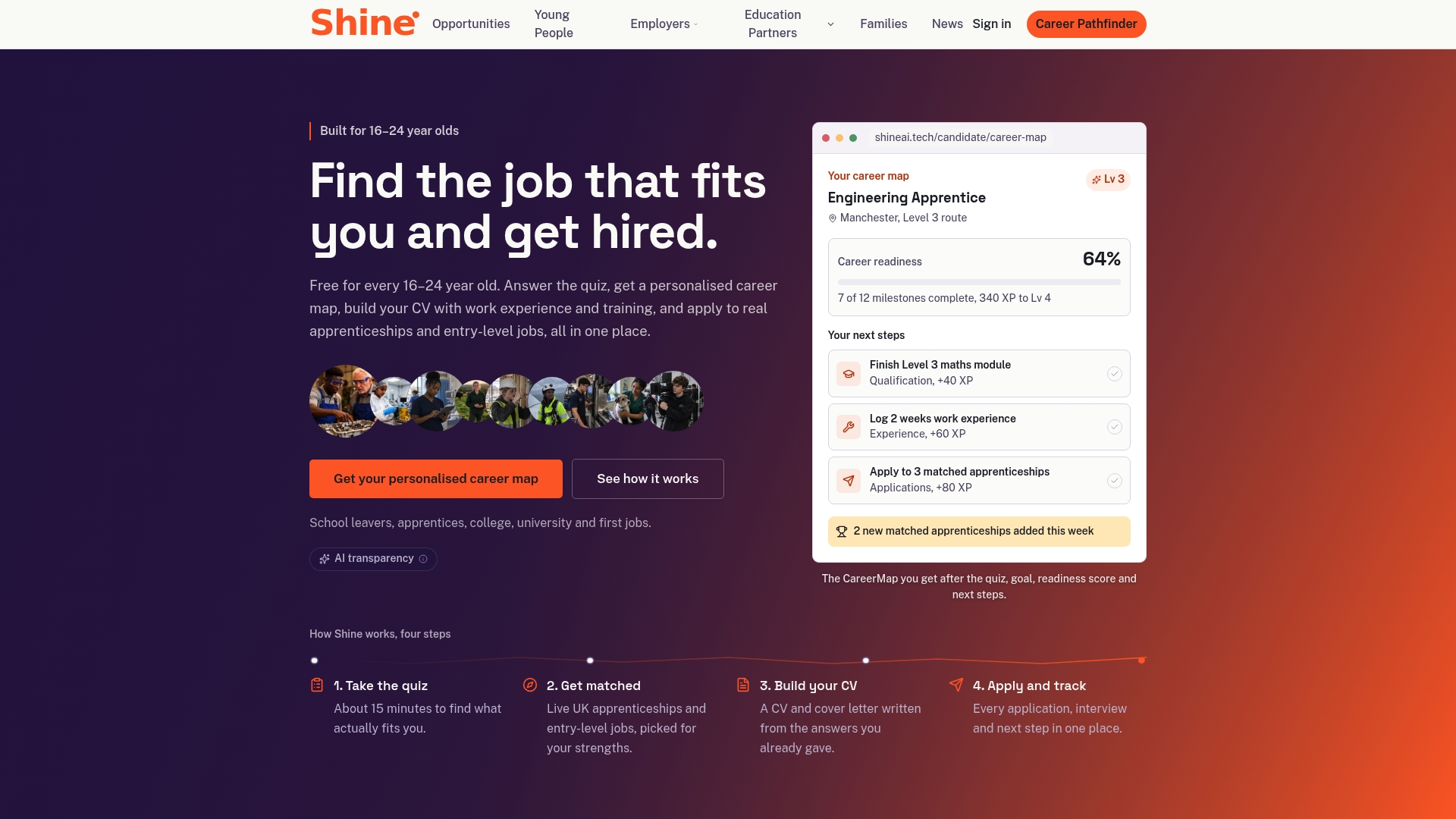
If you are a school, college or local authority supporting young people towards apprenticeships, we also offer learner progress tools and UK Skills Passport™. Young people can start with our free career quiz.
Common mistakes when recruiting apprentices
Writing the advert before choosing the training. The advert must name the training and provider, so you will end up rewriting it.
Treating the apprentice as cheap labour. The role must be relevant, paid at least the applicable minimum wage and include the agreed paid off-the-job training.
Hiding the wage. Candidates compare, and silence reads as low pay.
Screening on experience. Apprentices are meant to learn on the job. Experience requirements cut out the people the scheme exists for.
Ignoring the funding rules. Whether you pay the levy, your apprentice’s age and where the work happens all change what you pay. Our employer’s guide to the apprenticeship levy covers compliance in more detail.
FAQ
How do I recruit an apprentice for the first time?
Choose an approved standard and a training provider, agree the price, then advertise the role with the required details. Interview for potential, make the offer and sign the contract, apprenticeship agreement and training plan. Your provider can usually guide you through the process.
How much do I have to pay an apprentice?
From 1 April 2026 to 31 March 2027, at least £8 per hour if they are under 19 or aged 19 or over in their first year. After the first year, apprentices aged 19 or over must receive at least the minimum wage for their age. Pay for training time too. Check GOV.UK for the rate applicable when they start.
Do I need to pay the apprenticeship levy?
Only if your annual pay bill is over £3 million. The levy is 0.5% of pay bill, with a £15,000 allowance, per the levy guidance. Smaller employers do not pay it, and from August 2026 training for eligible 16 to 24 year olds is fully funded for non-levy employers.
How long does an apprenticeship last?
At least 8 months, and some run up to 6 years, with an average of about 2 years, according to the apprenticeships service. The length depends on the standard and the level.
Can I hire an apprentice from my existing staff?
Yes, if the training is new to them and the role fits the standard. Consider their prior experience and career aspirations when choosing the course and level, as the SCTP guidance suggests.
Sources
- What is an apprenticeship? (apprenticeships.gov.uk)
- How to take on an apprentice (GOV.UK)
- Search for apprenticeship standards (GOV.UK)
- How to choose the right apprenticeship training
- Choose a training provider
- Finding the right apprenticeship training course and provider (SCTP)
- Pay and conditions for apprentices (GOV.UK)
- Pay Apprenticeship Levy (GOV.UK)
- Apprentices: Costs, Hansard written answer, 2 March 2026
- Government’s £3bn apprenticeship overhaul (People Management)
- Recruit an apprentice in England (CITB)