
As the 2024 academic year progresses, UK employers are already looking toward the horizon. The cohort of school leavers entering the workforce in 2026 will represent a significant shift in the talent landscape. We are seeing the final wave of Gen Z meeting the very first of 'Gen Alpha'—a generation born into a fully tactile, high-speed digital world.
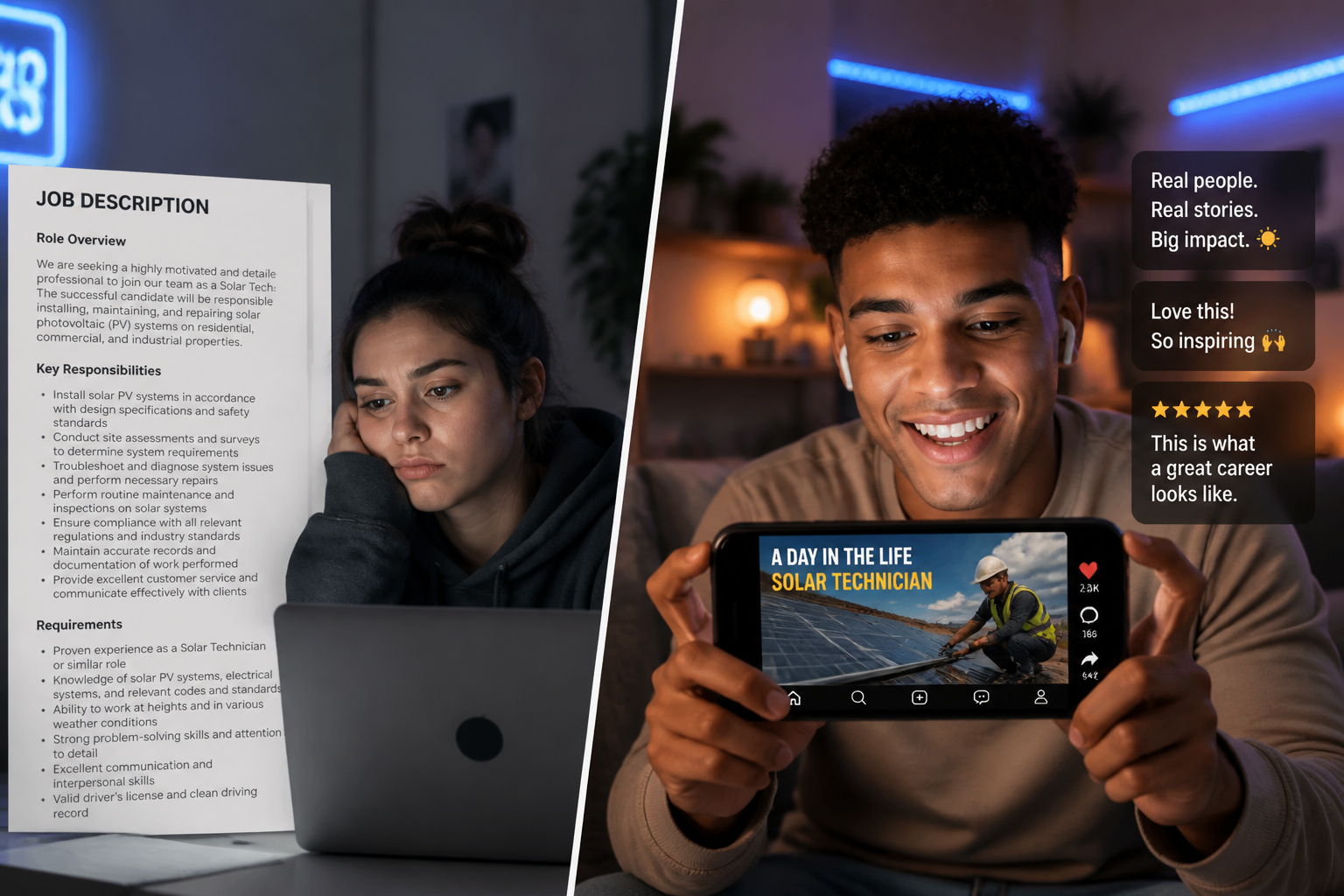
For these young people, the traditional recruitment funnel is failing. The 500-word job description and the text-heavy LinkedIn advert are increasingly invisible to a demographic that processes information through video, social proof, and rapid-fire authenticity. If your Gen Z recruitment trends UK strategy still relies on 'applying via our portal', you may find your 2026 pipeline looking remarkably thin.
Here is how to adapt your recruitment process to meet the next generation of school leavers on their own terms.
The Death of the 'Corporate Mask'
The most significant trend for 2026 is the total rejection of corporate polish. To a 17-year-old raised on TikTok and YouTube Shorts, a high-production-value recruitment video feels like an advertisement—and advertisements are things they have spent their lives learning to skip.
Instead, authenticity is the new currency. 2026’s school leavers want to see the 'unfiltered' version of your office or site. They are looking for 'Day in the Life' content that shows the commute, the lunch options, the actual desk they will sit at, and the people they will report to.
To attract this cohort, empower your current apprentices and junior staff to become your content creators. A smartphone-shot video of an apprentice explaining their biggest mistake and how they fixed it will garner more engagement and trust than a glossy interview with your CEO.
Short-Form Content as the New Job Spec
If you want to reach 16-to-18-year-olds, you have to go where they live: TikTok, Instagram Reels, and even YouTube Shorts. The 'job specification' is evolving from a PDF document into a 60-second video loop.
This doesn’t mean your HR team needs to start dancing. It means distilling your roles into their core components:
- The Vibe: What does the workplace actually feel like?
- The Impact: What will they actually do in their first week?
- The Reward: Beyond salary, what are the tangible benefits (flexible hours, social clubs, learning stipends)?
By the time a 2026 school leaver reaches your formal application page, they should already feel like they know your culture. The application itself should be a formality, not a discovery phase.
Rethinking the Barrier to Entry
The traditional CV is a legacy document that often penalises talented school leavers who haven't had the opportunity for high-end work experience. The 2026 cohort is increasingly aware of this bias.
Forward-thinking UK employers are moving toward 'low-friction' initial applications. This might involve:
- Gamified assessments: Testing natural aptitude and cognitive ability rather than past experience.
- Video intros: Letting candidates record a short clip answering a question instead of writing a cover letter.
- Skills-based hiring: Focussing on potential and digital fluency rather than A-Level subjects that may not correlate with the specific role.
Reducing the 'effort-to-apply' at the top of the funnel allows you to capture a wider, more diverse pool of talent who might otherwise be intimidated by a lengthy, formal process.
The Value Shift: Ethics and Stability
While Gen Z has long been associated with purpose-driven work, the 2026 cohort is entering a world defined by economic volatility. We are seeing a shift where 'stability' and 'clear progression' are becoming just as important as 'sustainability.'
When marketing to these leavers, be explicit about the career map. Show them where an entry-level role leads in three, five, and ten years. They are looking for an employer who will invest in their skills and provide a sense of security in an uncertain world.
Conclusion: Building the Bridge
Attracting 2026’s school leavers isn't about jumping on every social media trend; it’s about lowering the drawbridge. By trading corporate jargon for authentic storytelling and replacing rigid barriers with accessible entry points, you can build a pipeline that isn't just full, but truly representative of the future workforce.
The transition from school to work is a daunting one. The employers who win the talent war in 2026 will be those who make that transition feel like a conversation, not a hurdle.