
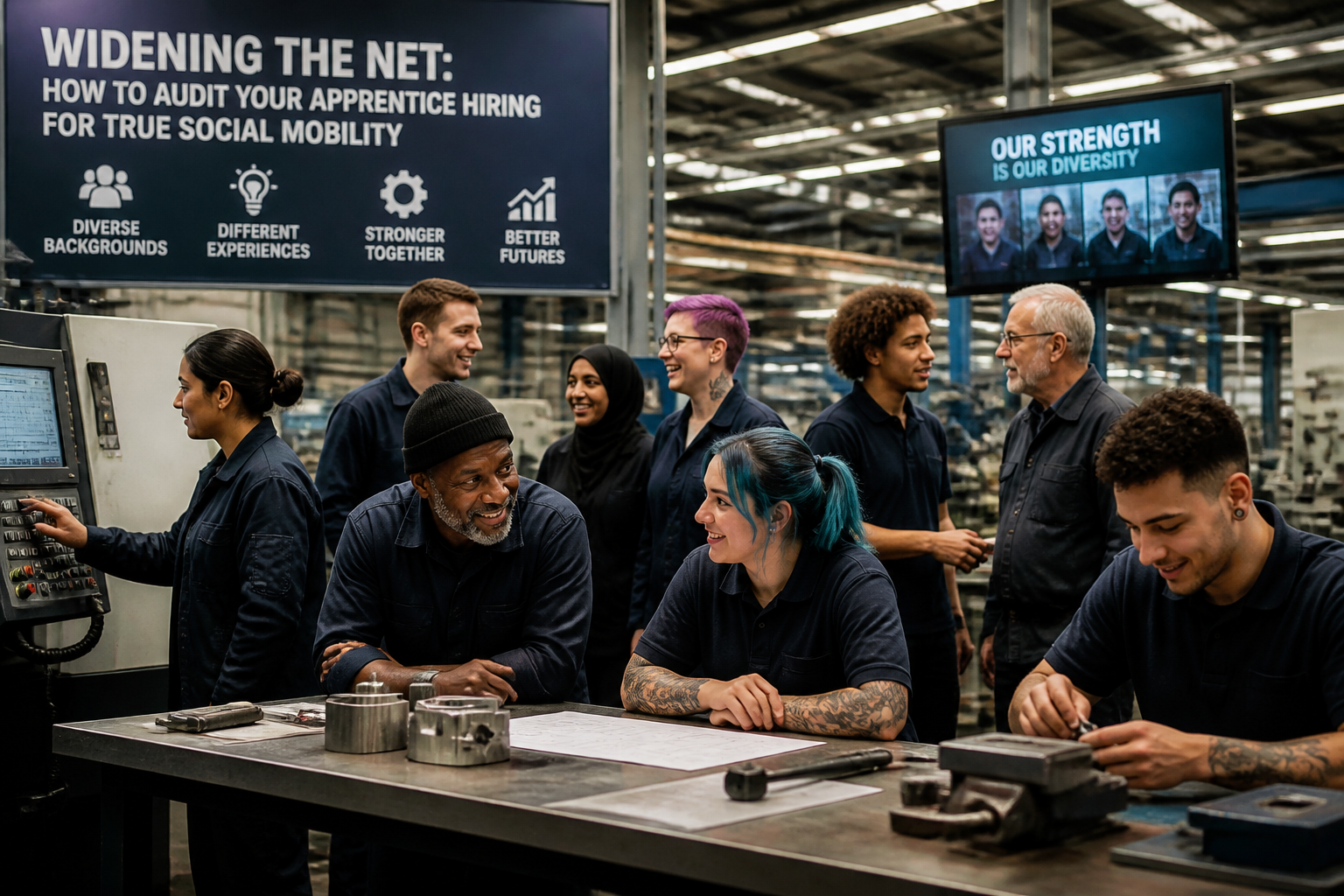
The conversation around apprenticeships in the UK has shifted. No longer are they seen merely as a 'corporate social responsibility' tick-box; they are now recognised as a vital engine for business growth and a primary lever for diversifying the workforce. However, as the UK moves toward more rigorous social mobility reporting standards, high-volume recruitment is no longer enough. Quality and inclusivity in the process are what matter.
If your apprenticeship intake consistently mirrors the demographics of your graduate scheme, you aren't yet tapping into the full potential of social mobility recruitment in the UK. Truly widening the net requires a forensic look at the barriers embedded within your hiring journey.
Here is a practical checklist for HR leaders to audit their apprentice hiring for true social mobility.
1. Deconstruct Your Job Descriptions
Social mobility is often hindered before a candidate even applies. Traditional corporate language can act as a 'coded' barrier that signals to those from lower socioeconomic backgrounds that they may not 'fit'.
The Audit:
- Remove ‘Heritage’ Requirements: Are you asking for UCAS points or specific GCSE grades that aren't strictly necessary for the role? Many talented individuals from disadvantaged backgrounds attend schools with lower average attainment; excluding them based on grades alone ignores their trajectory and resilience.
- Check the Jargon: Use tools to identify corporate-speak or gendered language. Keep descriptions clear, outcomes-focussed, and accessible.
- The ‘Invisible’ Costs: Does your job ad mention if travel costs for interviews are reimbursed? For a candidate from a low-income household, a £30 train ticket to your head office is a significant barrier.
2. Pivot from 'Experience' to 'Potential'
Standard recruitment often relies on 'polishing'—the ability of a candidate to present themselves with confidence, often hones through private schooling or professional networks. To improve social mobility, you must learn to look past the veneer.
The Audit:
- Strength-Based Assessments: Move away from competency-based questions that require previous work experience (e.g., "Tell me about a time you led a team"). Instead, use situational judgement tests that measure how they would react.
- Contextual Recruitment Tools (CRT): Are you using data to understand a candidate’s achievements in the context of their school and postcode? A 'B' grade at a struggling inner-city school can often represent a greater achievement than an 'A' at a top-tier private college.
- Blind Screening: Ensure names, addresses, and school names are redacted during the initial sift to mitigate affinity bias.
3. Review the Interview Experience
The interview is where social mobility often stalls. Unconscious bias leads managers to hire people who 'sound like them' or share similar hobbies.
The Audit:
- Diverse Panels: Ensure your interviewers represent different backgrounds, ages, and seniority levels.
- Task-Based Evaluation: Allow candidates to demonstrate their skills through a practical task relevant to the apprenticeship. This levels the playing field for those who struggle with the performative nature of traditional interviews.
- Briefing Your Managers: Even the most well-intentioned hiring manager might subconsciously penalise a candidate for poor eye contact or a lack of 'handshake confidence'—cultural markers that don't reflect job performance.
4. Track Your Data (Before the Mandate)
With the Social Mobility Commission and various industry bodies pushing for standardisation, UK employers should act now to gather the right data.
The Audit: To understand your baseline, you should ideally be asking three key questions during the application process (voluntarily):
- Type of school attended: (State-funded vs. independent).
- Eligibility for free school meals: This is often considered the most accurate measure of economic disadvantage.
- Parental occupation: What was the occupation of the main household earner when the candidate was 14?
By tracking these metrics through the funnel—from application to offer—you can identify exactly where candidates from lower socioeconomic backgrounds are dropping out.
5. Beyond the Offer: The 'Onboarding' Gap
Social mobility doesn't end on day one. Research shows that 'the class pay gap' often persists because of a lack of social capital within the workplace.
The Audit:
- Pre-boarding Support: Can you provide a 'buddy' before they start to answer the 'silly' questions about dress code or office etiquette?
- Financial Bridge: Apprentices often wait a month for their first paycheque. Consider offering a 'settling-in' grant or an advance on their salary to cover initial commuting costs and workwear.
Moving the needle on social mobility requires more than a shift in intention; it requires a shift in infrastructure. By auditing your apprenticeship hiring today, you aren't just preparing for future reporting standards—you’re ensuring your business is powered by the broadest, most resilient talent pool available in the UK.