
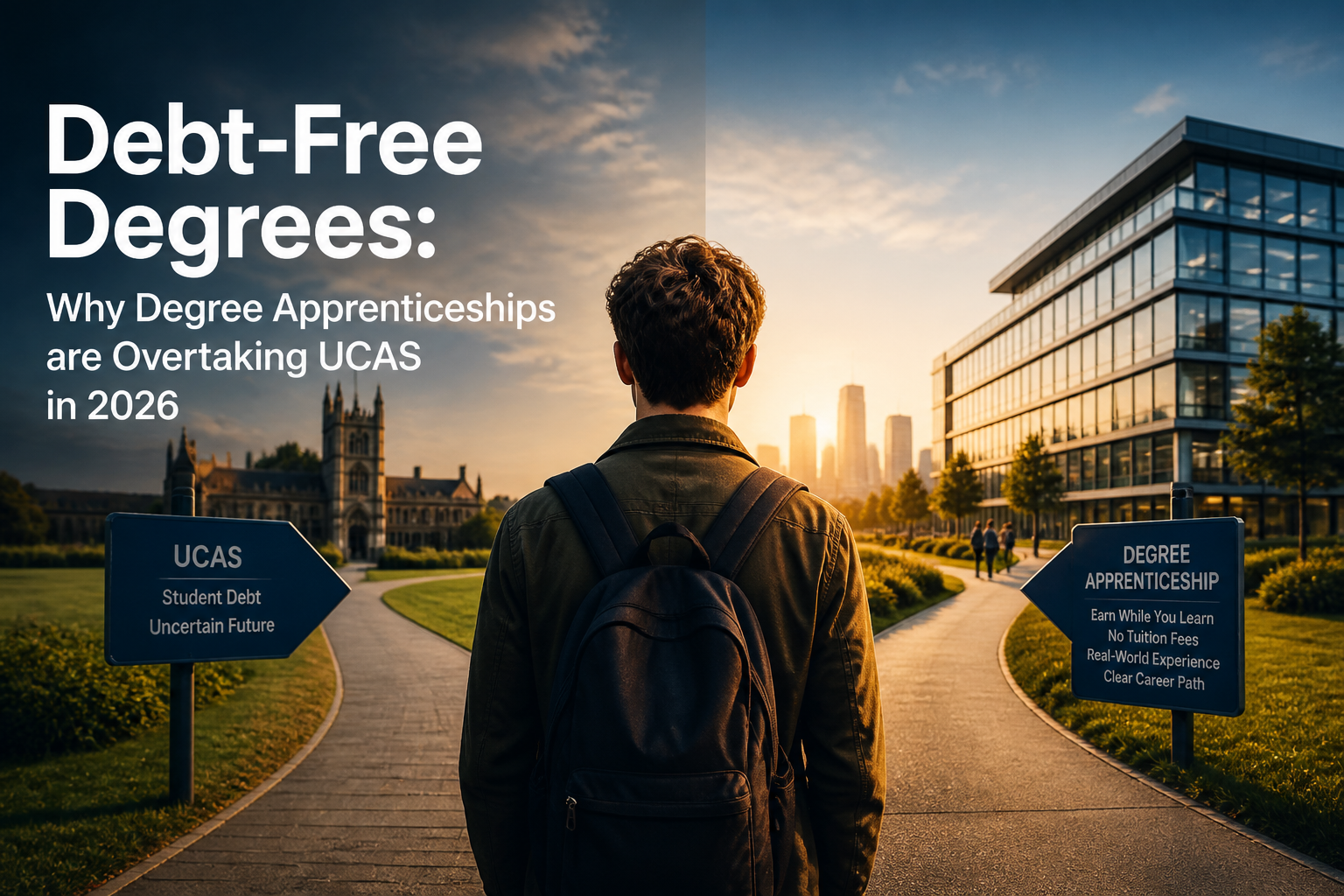
For decades, the standard path for school leavers has been clear: fill out your UCAS form, move into halls, and graduate with a kit of skills and a significant amount of student debt. But as we look toward 2026, the landscape is shifting. With tuition fees and living costs continuing to rise, a new heavyweight has entered the ring. Degree apprenticeships are no longer the 'alternative' choice; for many of the UK’s most ambitious young people, they are becoming the first choice.
The 'Best of Both Worlds' Model
The appeal of degree apprenticeships in 2026 boils down to a simple, life-changing equation: you get a full honours degree, zero tuition fees, and a competitive salary from day one. Unlike the traditional university route, where students currently graduate with an average debt of over £45,000, degree apprentices start their careers with a positive bank balance and three to four years of senior-level work experience.
In a degree apprenticeship, your time is usually split 80/20. You spend four days a week working within a professional team and one day studying at a partner university. By the time your peers are throwing their caps in the air at graduation, you aren’t just looking for your first job—you’ve likely already been promoted within one.
High-Growth Sectors: Beyond Trade Skills
One of the biggest myths about apprenticeships is that they are limited to manual trades. While those paths remain vital, the explosion of degree apprenticeships 2026 is happening in high-status, high-earning corporate sectors.
Data Science and AI: As companies scramble to integrate artificial intelligence, the demand for data specialists has skyrocketed. Tech giants and financial institutions are now hiring apprentices to learn data architecture on the job. You could be building machine learning models for a FTSE 100 company while your degree is funded by the very firm you're innovating for.
Law: The 'Solicitor Apprenticeship' is revolutionising the legal profession. Traditionally, becoming a solicitor required a self-funded degree followed by a competitive training contract. Now, you can join a law firm straight after A-Levels (or equivalent), earn a salary, and qualify as a solicitor in six years—all without a penny of student debt.
The Application Game: How it Differs from UCAS
It is important to manage expectations: degree apprenticeships are competitive. Because you are applying for a job as much as a degree, the process is more rigorous than a standard UCAS application.
While UCAS has a firm January deadline for most courses, degree apprenticeship vacancies open throughout the year. Many large firms, particularly in finance and engineering, open their applications as early as October for the following September’s intake. You will often need more than just a personal statement; expect online aptitude tests, video interviews, and assessment centres.
The good news? You can apply for as many degree apprenticeships as you like alongside your five UCAS choices. This "belt and braces" approach gives you the ultimate safety net.
Is it Right for You?
Before you ditch the UCAS website, it’s worth considering the lifestyle trade-offs. A degree apprenticeship is a job. You won’t get long summer holidays, and you’ll be balancing a 9-to-5 workload with university assignments. You need high levels of time management and maturity.
However, if you are someone who learns by doing, feels ready to enter the adult world, and wants to bypass the financial strain of the traditional student model, the "Level 6" path is unparalleled. You still get a graduation ceremony, you still get a degree certificate, and you still make lifelong friends—you just do it with a career already in flight.
Finding Your Path
As we move closer to the 2026 academic cycle, the number of available places is expected to hit record highs as the government and private sector continue to invest in the "earn while you learn" model. Companies are looking for potential, not just finished products. They want your energy, your fresh perspective, and your willingness to grow.
Whether you're eyeing a career in aerospace engineering, digital marketing, or international business, there is likely a degree apprenticeship that can get you there. Start your research early, polish your CV, and remember: in 2026, the smartest way to get a degree might just be to get a job first.